RAG vs Fine-Tuning: Which Does Your Business Actually Need?
Dor Peleg5 min read
Key takeaways
- RAG gives a model access to your knowledge at the moment it answers; fine-tuning changes how the model itself behaves.
- Choose RAG when answers depend on company data that changes, must be traceable to a source, or is restricted by user permissions.
- Fine-tuning fits when you need a consistent style, format or specialized behavior that prompting alone can't reliably produce.
- Fine-tuning is a poor way to teach a model facts: they go stale, can't be cited, and are expensive to update.
- Most business projects should start with good prompting and RAG, measure results with evaluations, and fine-tune only to close a specific remaining gap.
“Should we fine-tune a model on our data, or use RAG?” It’s one of the questions we hear most often from companies starting an AI project. It’s a good question, but it’s usually framed as either/or, when the two techniques solve different problems.
The short version: RAG is about what the model knows. Fine-tuning is about how the model behaves. Once you see it that way, most decisions become straightforward.
What is RAG, in plain terms?
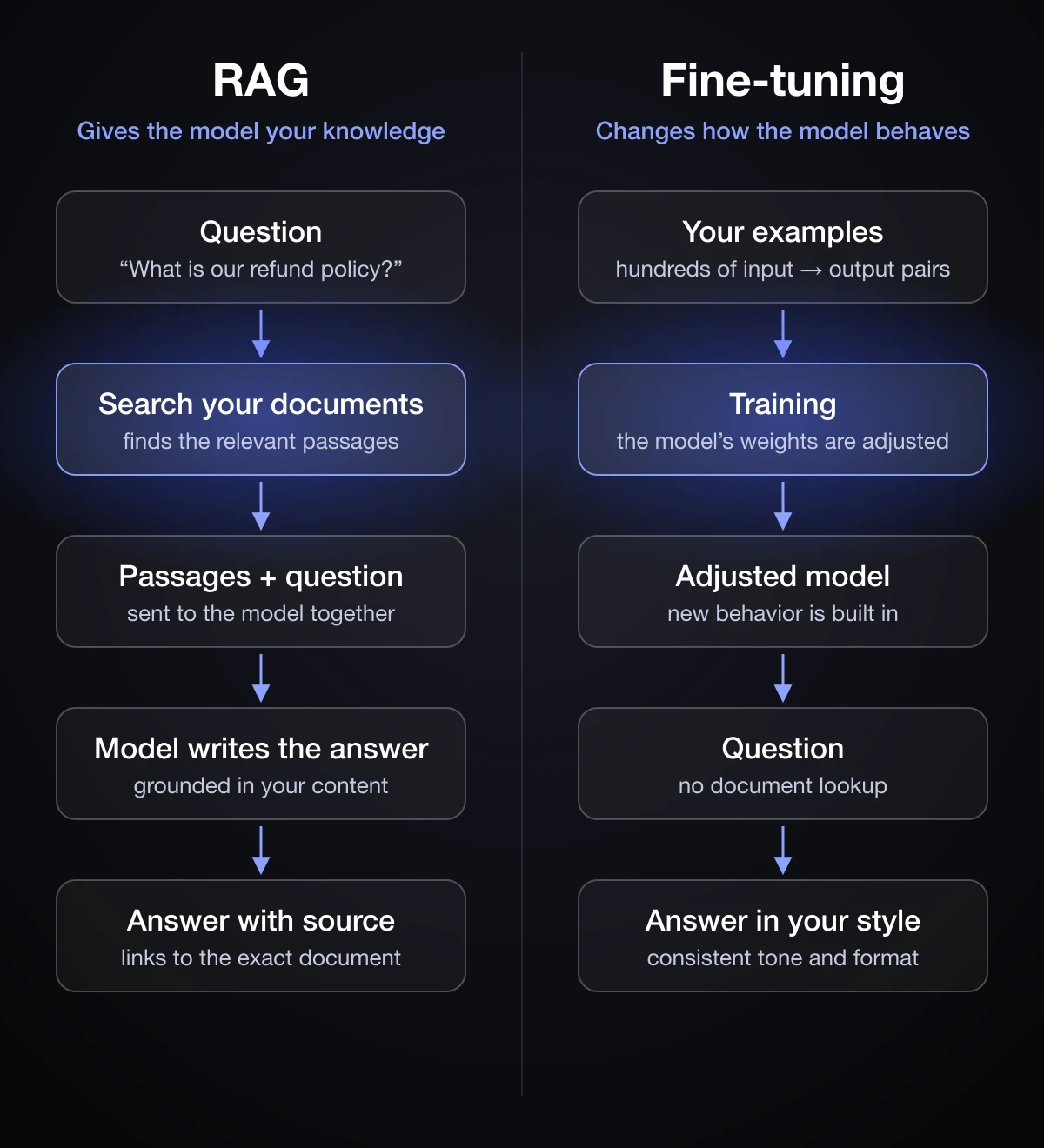
RAG (Retrieval-Augmented Generation) keeps the language model as it is and gives it the right information at the moment it answers.
When a user asks a question, the system first searches your knowledge sources (documents, wikis, tickets, databases) for the most relevant passages, usually with vector search. It then passes those passages to the model together with the question, and the model writes an answer grounded in them, often with a citation to the source.
Think of it as an open-book exam: the model doesn’t need to memorize your company, it just needs to find the right page and read it well.
What is fine-tuning, in plain terms?
Fine-tuning continues training an existing model on your own examples, so its internal weights change. You show it hundreds or thousands of input/output pairs, and it learns to respond in that pattern.
That’s powerful for shaping behavior: a consistent tone of voice, a strict output format, a specialized classification task, or domain-specific phrasing. It’s much less effective for keeping facts up to date, because whatever it learned is frozen at training time.
What is the real difference between RAG and fine-tuning?
| RAG | Fine-tuning | |
|---|---|---|
| Changes | What the model can look up | How the model responds |
| Best for | Company knowledge, documents, live data | Style, format, specialized behavior |
| Keeping it current | Update the documents, no retraining | Retrain with new examples |
| Citing sources | Yes, answers can point to the exact document | No, knowledge is baked into the weights |
| Access control | Can respect who is allowed to see what | Anything learned is available to every user |
| What you need | Your existing documents and data | A curated set of high-quality training examples |
When should you choose RAG?
RAG is the right starting point when:
- Answers depend on your company’s knowledge: policies, product documentation, contracts, past support cases.
- The information changes: prices, procedures and documents get updated, and the AI must reflect that immediately.
- People need to trust the answer: citations let users check the source instead of taking the model’s word for it.
- Not everyone may see everything: HR files, finance, client data. A well-built RAG system only retrieves what the asking user is allowed to access.
This covers the majority of business use cases we see: internal knowledge assistants, customer support bots, document search and analysis.
When does fine-tuning make sense?
Fine-tuning earns its cost when the problem is behavior rather than knowledge:
- You need strict, consistent output, such as a specific report structure or data format, at high volume.
- You need a specialized task done reliably, like classifying documents into your own categories or extracting fields in your own schema.
- You want a distinct voice or style that prompting can’t hold consistently.
- You want to run a smaller, cheaper model that performs a narrow task as well as a large general one.
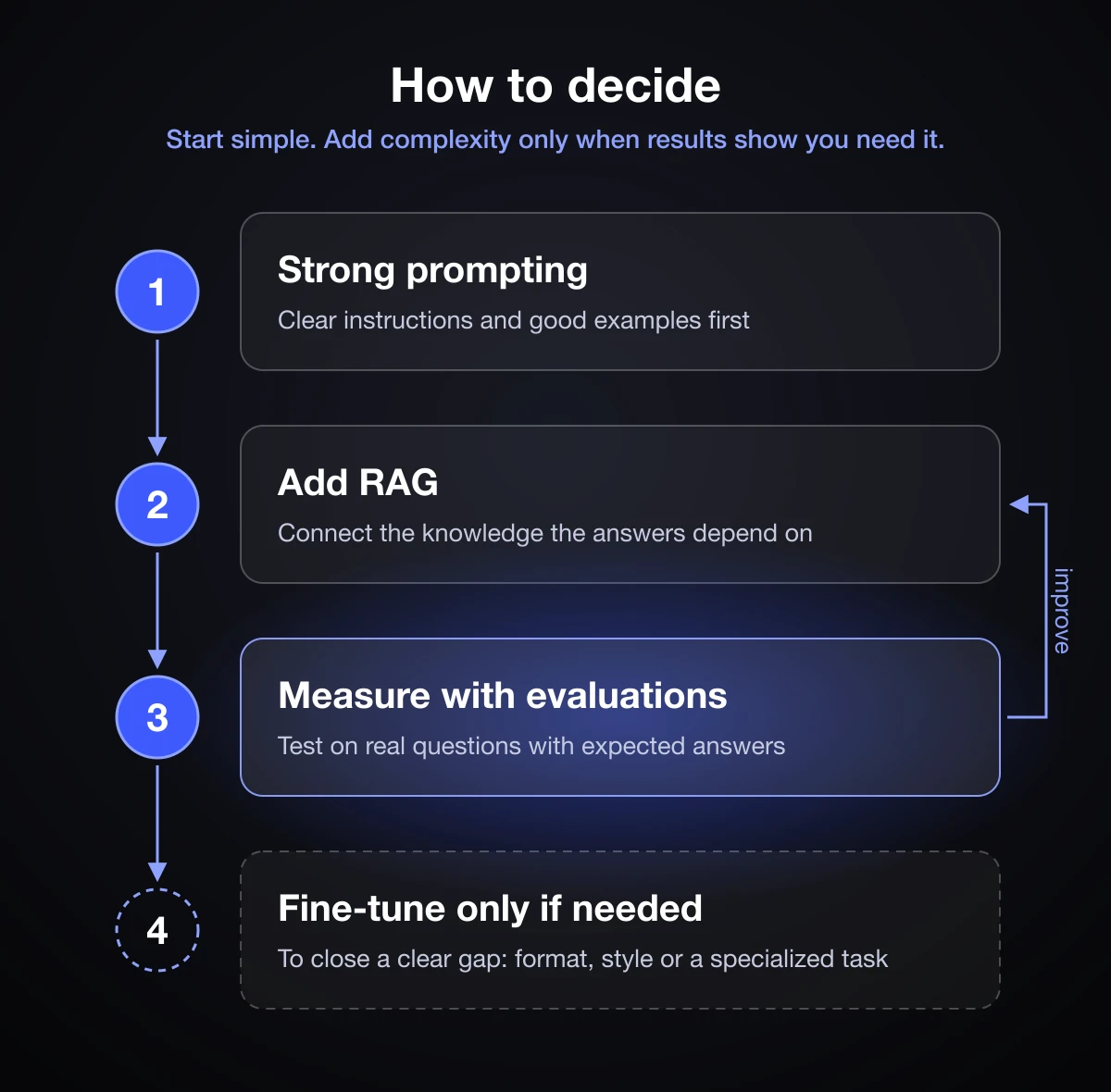
In each case, try strong prompting with good examples first. It often gets you most of the way, at a fraction of the effort.
Can you combine RAG and fine-tuning?
Yes, and mature systems often do. A common pattern is a model fine-tuned to follow your format and tone, sitting on top of a RAG pipeline that supplies the facts. The fine-tuning makes the answers consistent; the retrieval keeps them correct and current.
The key is order: get retrieval working and measured first, then fine-tune for whatever gap remains. Combining both from day one doubles the moving parts before you know which one actually needs work.
What mistakes do companies make when choosing?
- Fine-tuning to teach facts. It’s the most common one. The model may sound confident, but the facts go stale with every change, can’t be cited, and are hard to correct.
- Underestimating the data work. In RAG projects, the quality of ingestion, cleaning and chunking matters more than the choice of model. Messy documents in means messy answers out.
- Skipping evaluation. Without a test set of real questions and expected answers, every change is guesswork. Evaluations tell you whether a prompt change, a new retrieval setting or a fine-tune actually improved anything.
- Ignoring permissions. An assistant that can surface any document to any employee is a security incident waiting to happen.
How do we decide with clients at RILLOO?
We start from the problem, not the technique. In a typical project we:
- Define the questions the system must answer and build an evaluation set from real examples.
- Start with prompting and RAG, connecting the knowledge sources the answers depend on.
- Measure, then improve retrieval, chunking and prompts based on the results.
- Fine-tune only if a clear gap remains, such as format consistency or a specialized task.
Our projects reflect that balance. In our Smart Agent Assist for Salesforce, retrieval over past support cases with Pinecone cut Average Handling Time by up to 30%. In our legal archives project, the heavy lifting was the data pipeline: OCR correction and classification with Gemini, then semantic search over the cleaned text.
If you’re weighing RAG, fine-tuning or both for your own data, we’re happy to look at your use case and recommend the simplest approach that will work.