Replacing Wix and monday.com with a Custom System: Why It Makes Sense Now
Dor Peleg7 min read
Key takeaways
- AI-assisted development has cut the time it takes to build a custom website, admin panel or CRM, so custom is no longer only for large budgets.
- A custom system is built around the way a business actually works, and a custom website can be faster on mobile, better designed and better optimized for search than a template site.
- Per-seat and add-on pricing grows with every user and feature, while a custom system's running cost stays mostly flat as the team grows.
- A custom system can connect to any API, payment provider or AI agent, automate internal communication, and the business owns its code and its data.
- Custom systems need ongoing maintenance and a careful, professional build; for a small team with simple needs, Wix or monday.com is often still the right choice.
For years the sensible advice to a growing business was simple: put the website on Wix, run customers and projects in monday.com, and add paid apps when something is missing. Building your own system was slow, expensive and risky, so a ready-made platform was the safe choice.
That advice is changing. We now regularly help businesses replace their Wix site, their monday.com boards, or both, with one custom system: a website, an admin panel and a CRM that fit the business exactly. This article explains why that has become a realistic option, how to make the decision, and what it really takes.

Running the business, not the tools
What does “replacing Wix or monday.com” actually mean?
It usually comes in one of three forms:
- A website only. A Wix site is replaced by a fast, custom website the business fully controls, with its own content management.
- A website with customers and payments. Booking, registration, memberships, online payments and a customer area, all managed from one admin panel instead of a set of plugins and external apps.
- A full CRM or operations system. monday.com boards, spreadsheets and side tools are replaced by one system built around the business’s own process: customers, sales, scheduling, tasks, reports and automations.
In every case the result is one system, designed around the business, that connects to the other services it needs: payment providers, accounting, messaging, calendars, analytics, and AI agents.
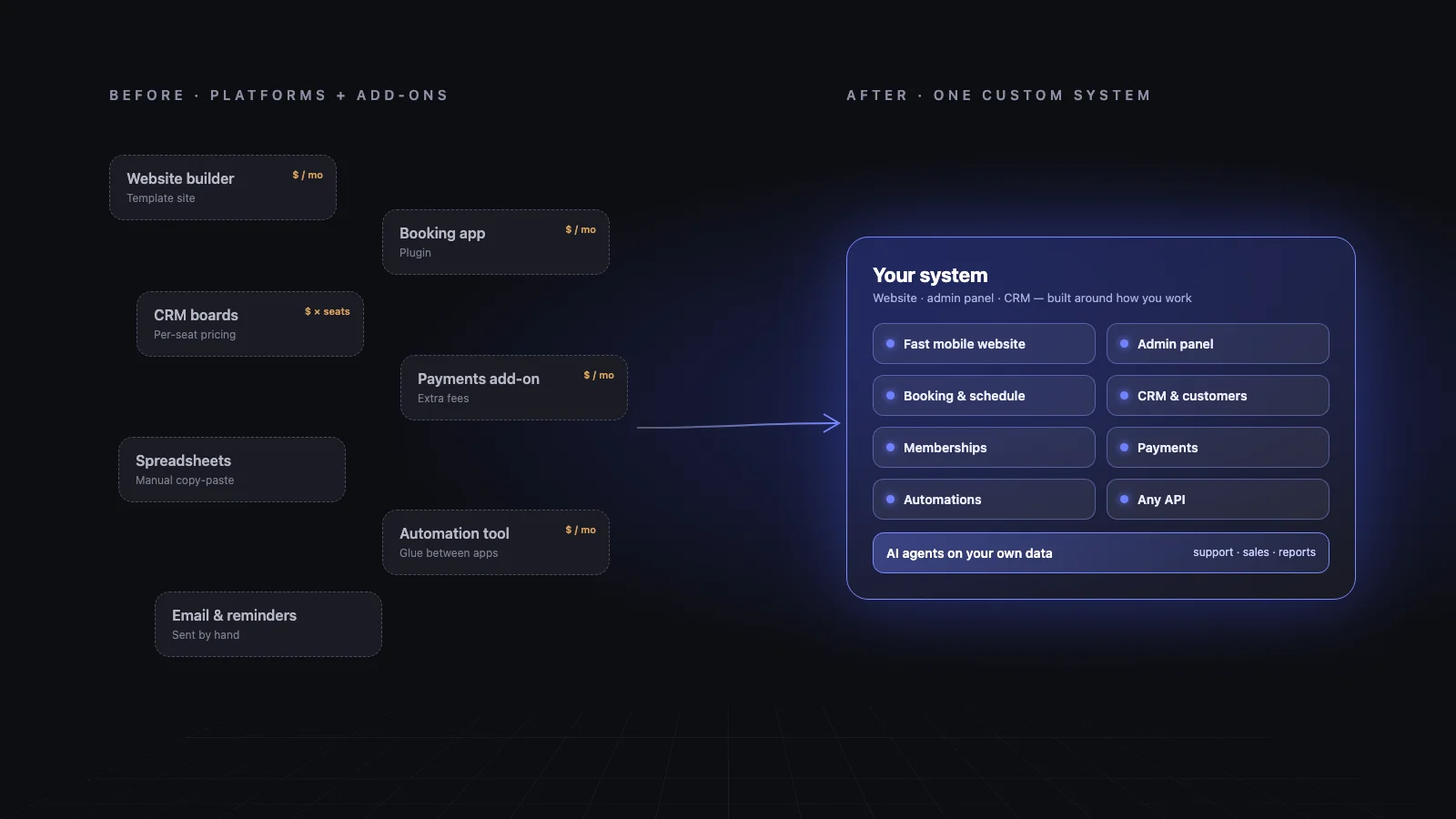
From a stack of platforms and add-ons to one system built around the business
Why is building custom faster today?
The biggest change is speed. Modern frameworks, managed cloud services and, above all, AI-assisted development have shortened the path from idea to working system. Work that used to take a team many months, such as screens, forms, database models, integrations and tests, can now be done in a fraction of the time by an experienced team that uses AI well.
That does not mean the software writes itself. It means engineers spend less time on repetitive code and more time on what matters: understanding the business, designing the data and the flows, and making the system secure and reliable. The result is that a custom website with an admin panel, or a custom CRM, is now within reach of businesses that would never have considered it a few years ago.
Why choose a custom system over Wix or monday.com?
A full fit to how you work
Wix and monday.com are built for millions of different businesses, so they cover the common case well and the specific case poorly. Over time, teams end up bending their process to fit the tool: workarounds, duplicate data entry, manual steps between apps, and fields that almost mean the right thing.
A custom system starts from the other side. It models your services, your customers, your pricing rules and your workflow exactly as they are, and changes when they change. Staff see the screens they need and nothing else, and customers get a journey that feels like your brand, not a template.
Faster, better designed and easier to find
Template platforms load a lot of code that a given site never uses, and their layouts and mobile behavior can only be adjusted so far. A custom website is built for its own content, so it can be much faster, especially on mobile, where most visitors arrive. Design and user experience are shaped around your brand and your customers’ real journey, not around a template’s limits, which makes the site look sharper and makes booking, buying or signing up easier.
Speed and structure also matter for search. A custom site gives full control over page structure, titles, structured data and performance, which gives it a stronger SEO foundation than a typical template site.
Integration with any API or AI agent
Platforms limit you to the integrations they support and the way they support them. A custom system can connect to any service with an API: your payment provider, invoicing and accounting, WhatsApp and email, calendars, government or industry systems, and your own data sources. Internal communication can be automated end to end: confirmations, reminders, staff alerts and updates between systems happen on their own instead of by hand.
It is also the natural home for AI. An AI agent that answers customers, books appointments, qualifies leads, summarizes customer history or prepares reports works best when it sits directly on your own data and your own logic. We wrote more about this in From Chatbots to AI Agents.
Cost that does not grow with every seat
Platform pricing looks small at the start. But monday.com and similar tools charge per seat, and both monday.com and Wix charge more for higher plans, extra features and paid apps. As the team grows and the business adds booking, payments, memberships or automations, the monthly bill grows with it, year after year.
A custom system has a different cost shape: an investment to build it, then hosting and maintenance. Hosting for a typical business system is modest, and it does not depend on how many employees log in. For a business with many users, or one paying for several add-ons, a custom system is often the more cost-effective choice within a few years, and it is an asset the business owns rather than a subscription it rents.
Ownership of your code and your data
With a custom system, the code and the data belong to you. You decide where the data is stored, who can access it and how it is used. You are not exposed to a vendor’s price changes, plan changes or product decisions, and moving to another provider later does not mean starting from zero. We cover this trade-off in more depth in Custom AI Development vs. Off-the-Shelf Software.
What does it take? Maintenance and a careful build
A custom system is not a “build it and forget it” project, and it is important to be honest about that.
- It needs maintenance. Dependencies need updates, security patches need to be applied, backups need to run and be tested, and the system needs monitoring. On Wix or monday.com the vendor does this for you; with a custom system someone has to own it.
- It has to be built carefully. Payments, customer data and logins leave no room for shortcuts. Security, permissions, data validation, error handling and testing must be part of the build from day one. Fast AI-generated prototypes that skip these steps tend to break in production, as we explained in The Reality of Vibe Coding.
- It needs a migration plan. Moving customers, history, content and SEO from the old platform has to be planned so nothing is lost and search rankings are kept.
When these are handled well, a custom system is stable and easy to grow. When they are skipped, it becomes a liability. This is why the choice of who builds and maintains the system matters as much as the decision to build.
When should you stay on Wix or monday.com?
Custom is not the right answer for everyone. A platform is often still the better choice when:
- You need a simple brochure website with a few pages and a contact form
- Your team is small and your process fits the platform well
- You do not need deep integrations, custom pricing or complex customer journeys
- You do not have a budget for ongoing maintenance
A custom system makes sense when:
- You keep paying for more seats, higher plans and add-ons to cover your needs
- Your team works around the tool instead of with it
- You need booking, memberships, payments or a customer area that the platform handles poorly
- Your site is slow on mobile, hard to rank in search, or limited by its template
- You want to connect your systems to each other, or add AI agents that work on your own data
- You want to own your code, your data and your roadmap
How we approach it
At RILLOO we have replaced Wix websites and monday.com setups for clients of different sizes, from a yoga studio that now has a faster, mobile-first website with better SEO and runs booking, schedule, memberships, payments and automations from its own system, to larger organizations with full custom CRM and operations platforms.
Every project starts by mapping how the business works today and what it pays for its current tools. From there we design a system that fits, build it with security and testing in place, migrate the existing data, and stay on to maintain it.
If you are wondering whether it is time to move off Wix or monday.com, we would be glad to look at your setup with you.